
He pitopito kōrero
News



News stories

Support services for people experiencing violence will still be available over the Christmas break. Contact details for support services are provided on our website.
The Campaign for Action on Family Violence has information about how to support someone you are worried about including what to say, how to help and looking after yourself.
The It's Not Ok Campaign has previously put out these holiday messages:
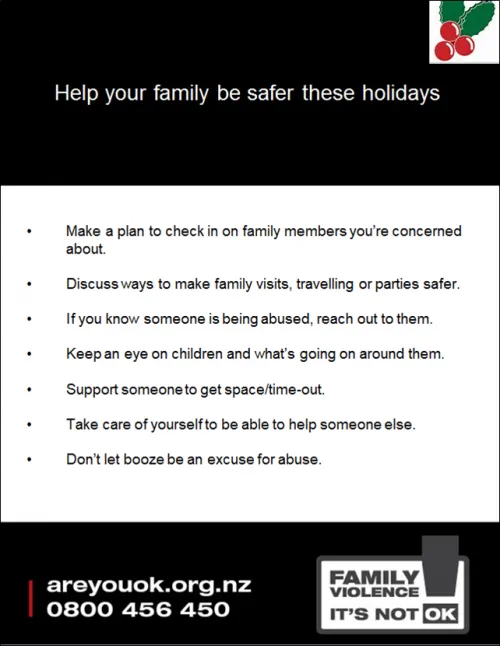
We hope that you are able to take some time out to be with your whānau, rest and rejuvenate over the holiday break.
We wish everyone a safe, happy and healthy break.

New resources for raising tamariki Māori
The recently published books from the Tiakina te Pā Harakeke project share tikanga and mātauranga for childrearing, with the aim of supporting whānau and growing wellbeing.
Since 2012, led by Leonie Pihama, Tiakina te Pā Harakeke – Raising a Treasured Child has investigated traditional knowledge, beliefs and practices of whānau and childrearing. The project looked at how communities can use these frameworks to support working with child abuse and neglect within whānau. The team focused on childrearing practices developed over generations in Māori communities based on understanding that tamariki are treasured.
Drawing on the mahi of the Tiakina te Pā Harakeke project, 2 books have been published to support whānau and grow wellbeing. The books focus on tikanga and mātauranga for childrearing.
Poipoia ngā tamariki: Māori proverbial sayings related to nurturing children (2022) is a book of more than 60 whakataukī showing traditional understanding and tikanga for raising children. The whakataukī have been selected by Leonie Pihama, Hineitimoana Greensill, Ngaropi Cameron-Raumati, Linda Tuhiwai Smith, Papahuia Dickson, Marjorie Beverland and Awhina Cameron. The book is published and sold by Tū Tama Wāhine o Taranaki. The book is a follow up to Taku Kuru Pounamu published in 2015, which shares a small selection of whakataukī.
Tiakina Te Pā Harakeke: Ancestral Knowledge and Tamariki Wellbeing (2022), edited by Jenny Lee-Morgan and Leonie Pihama, is a collection by Māori writers from throughout the motu about the values and tikanga of Māori childrearing developed by whānau over generations. The book is published by Huia and available from their website and bookstores. See the table of contents (abstracted from Amazon) including authors for each chapter:
- Introduction – Leonie Pihama and Jenny Lee-Morgan
- Taku kuru pounamu: Cherishing our children – Leonie Pihama
- He raranga mātauranga: Weaving ancestral knowledge – Donna Campbell
- Te taonga o taku ngākau: The wellbeing of tamariki within whānau – Leonie Pihama, Naomi Simmonds and Waikaremoana Waitoki
- He mokopuna he tupuna – Ngaropi Cameron-Raumati
- Whakatauākī: Sharing ancestral knowledge through generations – Hineitimoana Greensill, Leonie Pihama and Hōri Manuirirangi
- Oriori: He akoranga tahito: Oriori as knowledge transmission – Glenis Philip-Barbara and Hiria Barbara
- Tūī, tūī, tuituia: Pūrākau to keep us connected – Jenny Lee-Morgan
- Mātauranga-ā-whānau: Intergenerational knowledge transmission through whānau pūrākau – Marjorie Beverland
- Te kura mai i tawhiti: Ancestral knowledge and practice in Kaupapa Māori early years provision – Erana Hond-Flavell, Aroaro Tamati, Will Edwards, Ruakere Hond, Gareth J Treharne, Reremoana Theodore, Richie Poulton and Mihi Ratima
- Aro ki te wairua o te hā: The spirituality of birth – Naomi Simmonds and Teah Carlson
- Raranga wahakura: weaving wellbeing for mokopuna and whānau – Tanya White
- Wahakura and te whare pora o Hine-te-iwaiwa: Delving deeply into te pā harakeke – David Tipene-Leach and Sally Abel
- Oranga mokopuna: Ngā mōtika tangata whenua – Paula Toko King, Donna Cormack and Mark Kōpua
- Whiti-te-rā: A Māori-centred therapeutic approach to wellbeing – Andre McLachlin and Waikaremoana Waitoki.
To learn more about the Tiakina te Pā Harakeke project, listen and watch Leonie Pihama talk about the inspiration for the project in a video from Ngā Pae o te Māramatanga.
To explore this kaupapa more, see the following resources:
Te Taonga o Taku Ngākau: Ancestral knowledge as a framework for tamariki wellbeing project explored mātauranga Māori in the development of evidence-based, cultural interventions to improve the mental health and wellbeing of young Māori. The team published Te Taonga o Taku Ngākau Ancestral Knowledge and the Wellbeing of Tamariki Māori report (2019). Video recordings are available from a mini conference and thought space wānanga about the project including kōrero from Taina Whakaatere Pōhatu, Dr Naomi Simmonds, Dr Waikaremoana Waitoki and Hinewirangi Kohu Morgan.
Traditional Māori parenting: an historical review of literature of traditional Māori child rearing practices in pre-European times (2011) was published by Te Kahui Mana Ririki. The literature review explores Māori parenting practices and the philosophy supporting these practices before 1642. It focused on socialisation and discipline.
E Tū Whānau published Our Ancestors, a series of five resources highlighting how Māori cultural traditions protect wāhine, tamariki and tāne from violence and uphold the mana of all. The topics of the 5 resources are:
- Early observations of whānau
- Our ancestors were loving parents
- Our tāne ancestors were tender fathers
- Our ancestors were innovative, entrepreneurial, problem solvers
- Our wāhine ancestors were strong, influential and valued.
Update: Linda Tuhiwai Smith has published a series of illustrated books for tamariki. The pūrākau talk about difficult issues such as suicide and family violence to help tamariki talk about and process trauma. They are available in both English and Te Reo Māori from Huia Publishers.
Related news: New resources from E Tū Whānau
E Tū Whānau published new values booklets. There are 6 values that sit at the heart of the E Tū Whānau kaupapa: aroha, whakapapa, whanaungatanga, kōrero awhi, mana manaaki and tikanga. Announcing the booklets, the E Tū Whānau Pānui Hakihea 2022 says "These values strengthened and protected our tīpuna, and they continue to fortify and sustain strong, thriving whānau today."
E Tū Whānau created a set of booklets about each of the values. For each value, the booklet gives a Kupu Arataki, talks about key principles and practices, and shares Whānau Kōrero, Whānau Mahi.
Download the booklets from the E Tū Whānau website:
Printed booklets can be ordered in 2023 on the E Tū Whānau website.
Subscribe to E Tū Whānau's pānui to stay up to date with their mahi.
Related media
Pukapuka celebrates beautiful family, Waatea News, 15.06.2023
Picture books help tamariki through trauma, Waatea News, 21.04.2023

The International Day of Persons with Disabilities aims to promote an understanding of disability issues and mobilise support for the dignity, rights and well-being of disabled people. The theme for 2022 is "Transformative solutions for inclusive development: the role of innovation in fuelling an accessible and equitable world."
This year the UN Committee on the Rights of Persons with Disabilities looked at New Zealand's progress on the UN Convention on the Rights of Persons with Disabilities. Following this examination, the UN Committee published their Concluding observations on the combined second and third periodic reports of New Zealand (CRPD/C/NZL/CO/2-3) in September 2022.
The Committee made more than 50 recommendations in their concluding observations. Specific to article 16 of the Convention (Freedom from exploitation, violence and abuse) the Committee raised concerns about the high rates of violence experienced by disabled people, noting the high levels of gender-based violence experienced by women and girls with disabilities, including Māori and Pasifika women and girls with disabilities. The Committee also noted concern that "The National Strategy to Eliminate Family Violence and Sexual Violence is gender-neutral in relation to its focus on persons with disabilities."
In response to these concerns, the UN Committee recommends that (paragraph 32):
"...in close consultation with and with the active involvement of persons with disabilities, in particular women and girls with disabilities, including Māori and Pasifika women and girls with disabilities:
(a) Develop measures to address the high rates of violence experienced by persons with disabilities and to combat all forms of gender-based violence for inclusion within outcome area 4 of the New Zealand Disability Strategy;
(b) Incorporate gender-specific measures for the disability focus within the National Strategy to Eliminate Family Violence and Sexual Violence and ensure specific issues for women and girls with disabilities are mainstreamed throughout the Strategy."
The Committee also raised concerns that disabled people currently in institutional settings experience violence, abuse and neglect that is similar to violence identified through the Abuse in Care Royal Commission of Inquiry. In response, the Committee recommends (paragraph 34):
"The Committee recommends that urgent action be taken to amend legislative and policy frameworks that facilitate violence, abuse and neglect in institutions, to remove persons with disabilities from institutional settings with adequate support for living in the community, to investigate and sanction institutions and perpetrators and to provide victim and recovery support services and redress."
In relation to access to justice (article 13), the Committee raised concerns about the overrepresentation of disabled people in care and protection, youth justice and prison; and the lack of free independent advocacy and legal representation. In response, the Committee recommends that the State party (paragraph 24):
"(a) Develop a disability justice strategy to address the overrepresentation of persons with disabilities in the care and protection, youth justice and prison populations, including by strengthening age-appropriate procedural accommodations, measures to prevent persons with disabilities coming into contact with the justice system, and training on disability rights in the justice and care and protection systems;
(b) Establish and adequately resource free independent advocacy and increase resources for community legal advice services."
The Committee also raised issues in relation to adoption and recommends the State party (paragraph 46):
"(a) Repeal section 8 of the Adoption Act of 1955 and amend the statute to ensure that parents with disabilities are treated on an equal basis with other parents with respect to adoption;
(b) Implement strategies to increase family placements for children with disabilities and to ensure that siblings can remain together in these placements;
(c) Significantly increase and resource comprehensive information, services and supports for children with disabilities and their families to prevent out-of-home placements and placements in institutions, including residential specialist schools;
(d) Take immediate action within Oranga Tamariki (Ministry for Children) to implement the recommendations from the 2020 Ombudsman report, entitled “A matter of urgency”, and increase disability, gender and culturally appropriate expertise, policies and guidelines that adhere to the Convention in order to ensure that newborn babies and children are not removed from parents with disabilities, particularly parents with intellectual disabilities and Māori parents with disabilities, on the basis of impairment."
See the related media below for responses from advocates and the disability community.
More information
The UN Treaty Body Database for the 27th session of the Convention on the Rights of Persons with Disabilities provides access to the reports and documents related to the review. This includes the government's combined 2nd and 3rd periodic reports on the convention, reports from non-government agencies and the report from the NZ Human Rights Commission.
A delegation from New Zealand went to Geneva to present to the UN Committee meeting and answer questions. A video recording of the meeting is available. The Office of Disability Issues | Te Tarī Mō Ngā Take Hauātanga shared a summary of this meeting. The UN press release, Experts of the Committee on the Rights of Persons with Disabilities Commend New Zealand on Establishing the Disability Ministry, Ask Questions on Forced Sterilisation and Assisted Death (August 2022), also summarises the meeting.
The Independent Monitoring Mechanism (IMM) is a group of agencies that has been set up to monitor and report on the Government’s performance on the UN Convention on the Rights of Persons with Disabilities. Before the UN Committee review, the IMM published its third general update, Disability Rights: How is New Zealand doing, Ngā Motika Hauātanga: Kei te pēhea a Aotearoa? (2022). The report notes:
"For disabled people, it is fundamental that they have the same protection from violence and abuse as non-disabled people, and that agencies are positioned to prevent, and respond to the abuse disabled people experience. Monitoring frameworks and audit systems to report violence and abuse need to be accessible and fit-for-purpose."
When launching the report, Chief Ombudsman and IMM member Peter Boshier said:
“In my view, there is still a quantum leap required to remove disparities for disabled people in New Zealand... While the establishment of Whaikaha, the new Ministry of Disabled People, is encouraging, I am mindful that other government agencies still have a responsibility to progress their obligations under the Disability Convention. This report makes clear where government agencies need to focus and ensure agencies give effect to the ‘nothing about us without us’ mantra of the disability community.”
Response from government
Disability Issues Minister Poto Williams welcomed the observations from the UN Committee on the Rights of Persons with Disabilities saying:
"While we have made good progress since the last examination, the feedback will go far in shaping both future initiatives, and the government’s current approaches, such as the New Zealand Disability Strategy and Action Plan, the commitment to partnership in Whaikaha, transforming disability support services using an Enabling Good Lives approach, and the Accessibility for New Zealanders Bill."
The media release also noted that:
"Whaikaha will work with and support other government departments to help them deliver on the UN observations, and to ensure the Convention is incorporated across Government, which was signed in 2008, is adopted in full."
Update: In August 2023, the Government announced that it has agreed to progress 51 of the 60 Concluding Observations of the UN Committee on the Rights of Persons with Disabilities. It also "A further nine observations have been considered and noted." See Whaikaha for more information on the Government response including released Cabinet papers. Te Kāhui Tika Tangata Human Rights Commission expressed Concern that some key UN recommendations for improving disability rights not accepted by the Government.
Related news
Whaikaha - Ministry of Disabled People Chief Executive Paula Tesoriero is hosting online hui on a range of topics. The next session coming up on 15 December 2022 from 6:00 - 7:00pm is focused on Reflecting on our first six months and prioritising for the year ahead. To register email Whaikaha at communications@whaikaha.govt.nz. To hear about future sessions watch the Whaikaha Facebook page or sign up to their newsletters.
Oranga Tamariki is seeking feedback to help develop an Oranga Tamariki Disability Strategy. Oranga Tamariki is holding disability strategy workshops in December 2022 through February 2023 around the country for people to share feedback. There are other ways to give feedback. For more information contact Disability.Strategy@ot.govt.nz. This work is an initiative of the new Disability Advisory Group at Oranga Tamariki. As part of this work, Oranga Tamariki has published 5 research summaries on system changes, whānau support and connection, understanding disability, quality services and social work practices and policies.
Related reports
A new report highlights the "catastrophic failures" by the State to protect disabled and neurodiverse children, young people and adults in care. The report, Tell Me About You (2022), shares 16 stories of abuse survivors’ experiences in State and faith-based institutional care. It was commissioned by the Abuse in Care Royal Commission of Inquiry and prepared by the Donald Beasley Institute. The report is available in alternative formats including audio recordings of the storytellers. In launching the report, Abuse in Care Commissioner Paul Gibson said "Every child, young person and adult has the right to thrive and live their best life. Those abused in care were denied that by the very people and systems that were set up to care for them."
Research has shown that disabled people are more likely to experience intimate partner violence and/or sexual violence in Aotearoa New Zealand. For more information see the articles Lifetime prevalence of intimate partner violence and disability: Results from a population-based study in New Zealand (2021) and Prevalence of nonpartner physical and sexual violence against people with disabilities (2021).
The Human Rights Commission previously published two reports about the experiences of violence and abuse among tāngata whaikaha Māori and disabled people. The reports, Whakamanahia Te Tiriti, Whakahaumarutia te Tangata (Honour the Treaty, Protect the Person, 2021) and Whakamahia te Tūkino kore Ināianei, ā Muri Ake Nei (Acting Now for a Violence and Abuse Free Future, 2021), outline the evidence on the causes and impacts of violence including racism and colonisation, and abuse against tāngata whaikaha Māori and disabled people. The reports outline gaps in systems, knowledge and services and set out a roadmap for systemic change. Together the reports make 20 recommendations.
Te Pou, on behalf of Mānatu Hauora Ministry of Health and Whaikaha - Ministry of Disabled People, is leading the Equitable Access to Wellbeing project. The project is working towards improving opportunities and outcomes for disabled people experiencing mental distress. The aim of this work is to provide resources and initiatives that strengthen the workforce to support people with lived experience and their whānau. Te Pou published the Equitable Access to Wellbeing framework (2022). It is a knowledge and skills framework for mental health, addiction, and disability workforces working in primary, secondary, and tertiary contexts. Te Pou is a national workforce centre for mental health, addiction and disability in New Zealand.
Heather Came has published the article, A critical Tiriti analysis of the New Zealand Disability Strategy 2016-2026.
Several international reports and resources have also recently been published:
- Changing the landscape: a national resource to prevent violence against women and girls with disabilities (2022) and Prevention of violence against women and girls with disabilities: background paper by Our Watch and Women with Disabilities Victoria, Australia
- Violence, abuse, neglect and exploitation of LGBTQA+ people with disability: a secondary analysis of data from two national surveys (2022) published by Australian Research Centre in Sex, Health and Society, La Trobe University, Australia
- The nature and extent of domestic and family violence exposure for children and young people with disability (2022), ANROWS Research report Issue 16 and Connecting the dots: Understanding the domestic and family violence experiences of children and young people with disability within and across sectors (2022), ANROWS Research report, Issue 17, Australia
- Global report on health equity for persons with disabilities (2022) by the World Health Organization
- Disability justice and primary prevention webinar Part 1: Moving at the speed of trust (2022), Prevent Connect, USA.
Find more related research, reports and resources by searching our library under the quick topics - disabled people and tāngata whaikaha.
Related media
Government unmoved on 'ableist' immigration policy despite UN critique, Stuff, 29.08.2023
UN expert calls for ‘new philosophy’ to better serve persons with disabilities, UN News, 13.03.2023
'How long must we wait?' Disabled people want stronger accessibility legislation, Stuff, 27.02.2023
Dr Huhana Hickey / What the year has dealt for the disabled, Waatea News, 13.12.2022
Disability rights – back to basics, Wairarapa Times-Age, 11.12.2022
Greens call on every party to improve accessibility, Green Party press release, 05.12.2022
Like 'drinking from a fire hose' says Whaikaha boss of new role, Stuff, 03.12.2022
Care of disabled people a 'catastrophic failure', report finds, Stuff, 03.12.2022
'What we did to disabled children and their families was beyond wrong', Stuff, 03.12.2022
Minister acknowledges pain caused by justice gap for people with disabilities, Newsroom, 11.10.2022
UN disability rights experts concerned with NZ progress, call for urgent action, Stuff, 19.09.2022
UN committee 'concerned' NZ Government ignoring disability rights' advice, Stuff, 27.08.2022
United Nations to review progress for disabled New Zealanders, Beehive media release, 21.08.2022

UN report on violence against women and girls in digital contexts
The United Nations Secretary-General published a report for the 77th session of the UN General Assembly.
The report, Intensification of efforts to eliminate all forms of violence against women A/77/302 (2022), focuses on "...the urgent need to address violence against women and girls in digital contexts" and the broader work to eliminate violence against women in the context of the COVID-19 pandemic.
The report states that:
"...The coronavirus disease (COVID-19) pandemic exemplified how crises exacerbate the drivers of violence against women and create barriers to accessing essential services as resources are diverted to respond to the emergency. The pandemic exposed pre-existing gaps in responses to survivors and stalled progress in prevention."
Specifically, it states that violence against women and girls in digital contexts escalated, noting that:
"As lives shifted online for work, school, access to services and social activities, reports emerged of a surge in violence against women and girls in digital contexts."
Key points from the report in the overview of online violence include:
- There are many forms of violence against women in digital contexts which spans sexual harassment, intimate partner and domestic violence, trafficking and more. This violence "...often occurs as part of a continuum that is connected to offline violence."
- There is no internationally agreed definition of violence against women in digital contexts (the report highlights the definition from the UN Special Rapporteur on violence against women in her report on online violence against women and girls, A/HRC/38/47).
- New forms and patterns of online violence continue to evolve as technology evolves and these "... continue to multiply in a context of rapidly expanding digitalization, accelerated by the pandemic."
- New forms of violence have been made worse by the growth of artificial intelligence, and increasing numbers of extremist groups and incels engaging in online harassment.
- Studies show that online violence against women and girls often precedes offline violence against women and girls.
- Prevalence is hard to measure with no agreed international definition nor method of measurement. The report cites a global study and country specific studies that indicate more than 30% of women personally experience online violence.
- Young women and girls are at increased risk for being targeted with online violence. While men are also victims, the gender differences for online violence are similar to those as violence in the physical world with women and girls more likely to experience gendered violence.
- Ethnic women, indigenous women, lesbian, bisexual and transgender women, and women with disabilities are at greater risk for experiencing online violence.
- Online violence causes significant harm and impacts on women's participation in public life.
In discussing the drivers, the report states:
"Although the patterns and forms of violence against women in digital spaces can be unique, they are part of the continuum of multiple, recurring and interrelated forms of violence across online and offline spaces. Many forms of violence occurring offline are replicated and intensified in digital spaces. Digital spaces reflect, reinforce and exacerbate systemic structural gender inequality, deep-seated cultural and social norms as well as patterns of harmful masculinities that drive all forms of violence against women.
The report identifies several areas where change is needed. It highlights that current laws do not have clear and consistent definitions, and have not kept pace with technology and different forms of online violence. It further states that "Even when laws are in place, law enforcement personnel often do not treat online violence as seriously as physical violence and lack the skills and capability to identify and respond appropriately to such violence." Self-regulation and voluntary measures for technology providers have issues with weak enforcement and lack of sanctions, accountability and independent oversight.
The report identifies and outlines action needed to drive change in 4 areas:
- Consistent laws, regulatory frameworks and effective implementation
- Responsibility of technology intermediaries to prevent and respond
- Improving data and transparency
- Developing partnerships between governments, technology providers and women’s rights organisations.
Within these areas the report calls for systems that "...ensure safe and accessible reporting pathways, support and responses for women who experience violence and abuse."
The report highlights that state obligations to protect human rights have been clearly outlined in the UN Special Rapporteur's report on online violence against women and girls, A/HRC/38/47. The report further notes that rights of digital users have been used to challenge human rights protections and states:
"Nevertheless, the right to freedom of expression cannot be invoked to justify language or other forms of expression designed to incite discrimination, hostility or violence, including online violence against women and girls."
The report concludes with 7 broad recommendations for states and technology intermediaries, and it also notes that the upcoming 67th Session of the Commission on the Status of Women provides an opportunity for strengthening normative frameworks to address violence against women and girls in digital contexts.
UN Women published the policy brief Accelerating efforts to tackle online and technology-facilitated violence against women and girls (2022). The brief summarises global data and research about online violence. It also highlights examples from other countries and concludes with a more detailed list of recommendations for the UN system, states and the technology sector.
Update: UN Women published several documents related to technology facilitated violence against women including:
Technology-facilitated violence against women: Taking stock of evidence and data collection (2023)
Brief: The state of evidence and data collection on technology-facilitated violence against women (2023)
Recent research from Aotearoa and Australia
Researchers interviewed 25 victim-survivors in Aotearoa New Zealand about their experiences of image-based sexual abuse. The participants, mostly women, described a range of experiences of image-based abuse with 68% of participants reporting the perpetrator was a partner or former partner, and for 52% of participants, there was a pattern of abuse and controlling behaviours. Few participants reported the abuse to police and some victim-survivors talked about receiving hostile and negative reactions after they disclosed their experiences to friends, family and others. The authors examined the limitations of the Harmful Digital Communications Act for addressing the experiences of the victim-survivors, noting "...the inadequacies of the legal framework for responding to the diverse experiences of image-based sexual abuse." Victim-survivors also identified a range of desired justice outcomes and responses, but all agreed on the "...importance of justice, redress and support – through formal justice avenues, such as police, or civil or criminal proceedings, as well as through more informal support avenues such as victim advocacy services or family, whānau, friends, workplaces or schools." The findings from the research were published in the article ‘Devastating, like it broke me’: Responding to image-based sexual abuse in Aotearoa New Zealand (2022) published in the Criminology & Criminal Justice journal. The research was part of a larger study about the experiences of victim-survivors of image-based abuse in Australia, New Zealand and the UK.
Researchers in Australia have published findings from their first nationally representative survey of the prevalence, nature and harms of technology-facilitated abuse. The study surveyed 4,562 adults in Australia and included interviews with 20 adult victim-survivors and 10 perpetrators. The study found that half of Australians will experience technology-facilitated abuse in their lifetime. Reports, factsheets and a recorded presentation highlight the findings from the Technology-facilitated abuse: Extent, nature and responses in the Australian community project. Also see the brief article, Half of Australians will experience technology-facilitated abuse in their lifetimes: new research (2022), from media outlet The Conversation.
The Australian Institute of Criminology published, Image-based abuse: Gender differences in bystander experiences and responses (2022), a brief summary of findings from a survey of 245 Australian adults about their experiences of witnessing image-based abuse as a bystander.
Related international news
The Platform of Independent Expert Mechanisms on Discrimination and Violence against Women (EDVAW Platform) has also recently published a thematic paper on the digital dimension of violence against women. This thematic paper was adopted by the EDVAW Platform at its 14th meeting held online on 17 November 2022, under the presidency of the Council of Europe Expert Group on Action against Violence against Women and Domestic Violence (GREVIO). It gives an overview of the nature, scale and impacts of online and technology-facilitated violence against women. It also looks at related international mandates, and approaches, promising practices and challenges in addressing the digital dimension of violence against women.
The World Health Organization (WHO) published the report What works to prevent online violence against children (2022). The report presents ways to address the keeping children safe online with a focus on 2 forms of online violence: child sexual abuse including grooming and sexual image abuse and cyber aggression and harassment in the form of cyberbullying, cyberstalking, hacking and identity theft. For more information see WHO infographics about online violence against children and the WHO factsheet violence against children.
The UN Working Group on discrimination against women and girls published the report Girls’ and young women’s activism - Report of the Working Group on discrimination against women and girls, A/HRC/50/25 (2022). As part of this work, the Working Group created an interactive website that draws on the report focused on Making sure girls and young women are always heard.
Related media
Filmmaker Rosie Morris on the reality of deepfake porn, RNZ, 04.11.2023
Māori tech solutions are key to helping those scammed online, Te Ao Māori News, 01.11.2023
Indigenous women share racist online experiences at conference, Te Karere TVNZ, 29.10.2023
Amokura Panoho | Member of Te Pūkotahitanga, Waatea News, 25.10.2023
'Rampant' increase of digital harm on indigenous women, conference told, Stuff, 25.10.2023
The harsh and unregulated reality of online safety for indigenous women, NZ Herald, 25.10.2023
Abuse warning from Davis as women step up, Waatea News, 24.01.2023
Bright Sky NZ: How apps could help address our family violence problem, The Spinoff, 23.01.2023
Calls to ban violent offenders from dating apps in Australia, One News, 23.01.2023
Scope of revenge porn law too narrow, no care offered to victims - advocate, RNZ, 09.12.2022
Anti-revenge porn campaigners want more law changes, RNZ, 09.12.2022
Leaders push back against sexist, racist abuse online, Newsroom, 06.12.2022
Twitter snubs Netsafe, NZ white nationalist group rejoins, NZ Herald, 02.12.2022
Independent review finds systemic racism at InternetNZ following Māori threat video, RNZ, 29.11.2022
Internet NZ apologises to Māori after fallout over racist video, Stuff, 23.11.2022
Experts concerned over the rise of deepfake technology, Newshub, 29.10.2022

UN committee calls for states to take action
The UN Committee on the Elimination of Discrimination against Women (the Committee) issued a General Recommendation which addresses states' obligations for the rights of Indigenous Women and Girls under the Convention on the Elimination of All Forms of Discrimination against Women (the Convention).
General Recommendation No. 39 (CEDAW/C/GC/39) "identifies and addresses different forms of intersectional discrimination faced by Indigenous Women and Girls, and their key role as leaders, knowledge-bearers, and culture transmitters within their peoples, communities, families, and society as a whole."
The Committee identifies patterns of discrimination, including gender-based violence, and the factors that make discrimination worse, including a lack of access to justice.
They highlight that discrimination is often intersectional. The Committee calls on States to consider the full depth and diversity of Indigenous women's identities and the importance of Indigenous women's connection to their peoples, lands, natural resources, and culture. In paragraph 3 of the General Recommendation the Committee states:
"Intersectional discrimination against Indigenous Women and Girls must be understood taking into consideration the multifaceted nature of their identity. As Indigenous Women and Girls, they face discrimination and gender-based violence frequently committed by state and non-state actors. These forms of violence and discrimination are widespread and often remain in impunity. Indigenous Women and Girls also often have an inextricable link and relation to their peoples, lands, territories, natural resources, and culture."
In paragraphs 4 and 5, the Committee provides a more detailed explanation of the approach that States should take to prevent and address discrimination. It also says States must take an approach that:
- has a gender perspective
- is intersectional
- is intercultural
- is multidisciplinary.
The Committee examines a number of human rights and outlines specific obligations and recommendations for States under each human right. The rights addressed include:
- Equality and non-discrimination, with a focus on Indigenous women and intersecting forms of discrimination
- Access to justice and plural legal systems
- Prevention of and protection from gender-based violence against Indigenous women and girls
- Right to effective participation in political and public life
- Right to education
- Right to work
- Right to health
- Right to culture
- Rights to land, territories and natural resources
- Rights to food, water and seeds
- Right to a clean, healthy and sustainable environment.
Specific to the prevention of and protection from gender-based violence, the Committee states:
"Gender-based violence against Indigenous women and girls undermines the collective spiritual, cultural and social fabric of Indigenous Peoples and their communities and causes collective and sometimes intergenerational harm."
The Committee calls for legal systems and services that respond to Indigenous women's experience of violence saying:
"States should have an effective legal framework and adequate support services in place to address gender-based violence against Indigenous Women and Girls. This framework must include measures to prevent, investigate, punish perpetrators, and provide assistance and reparations to Indigenous Women and Girls who are victims, as well as services to address and mitigate the harmful effects of gender-based violence."
The Committee notes that this applies to all levels of the legal system and the many organisations and individuals involved in the legal system saying:
"This general obligation extends to all areas of State action, including the legislative, executive, and judicial branches, at the national, regional and local levels, as well as privatized services. They require the formulation of legal norms, including at the constitutional level, and the design of public policies, programs, institutional frameworks and monitoring mechanisms, aimed at eliminating all forms of gender-based violence against Indigenous Women and Girls, whether committed by State or non-State actors."
There are 9 recommendations specifically addressing gender-based violence for state parties. See the full text of these recommendations below.
These are part of 69 total recommendations identified by the UN Committee "calling on states to immediately develop and implement comprehensive policies to better protect the human rights of Indigenous women and girls everywhere." Many of the recommendations from the other human rights categories relate to violence against Indigenous women.
Recommendations addressing the Prevention of and protection from gender-based violence against Indigenous women and girls:
"(a) Adopt and effectively implement legislation that prevents, prohibits, and responds to gender-based violence against Indigenous Women and Girls incorporating a gender, Indigenous Women and Girls, intersectional, intercultural, and multidisciplinary perspective, as defined in paragraphs 4 and 5 of this General Recommendation. Legislation and its implementation should also adequately consider the life cycle of all Indigenous Girls and Women, including those with disabilities;
(b) Recognize, prevent, address, sanction, and eradicate all forms of gender-based violence against Indigenous Women and Girls, including environmental, spiritual, political, structural, institutional, cultural violence, and that attributable to extractive industries;
(c) Ensure that Indigenous Women and Girls have timely and effective access to both non-indigenous and indigenous justice systems, including protection orders and prevention mechanisms when needed, and the effective investigation of cases of missing and murdered Indigenous Women and Girls free from all forms of discrimination and bias;
(d) Repeal all laws that prevent or deter Indigenous Women and Girls from reporting gender-based violence, such as guardianship laws that deprive women of legal capacity or restrict the ability of women with disabilities to testify in court; the practice of so-called “protective custody”; restrictive immigration laws that discourage women, including migrant and non-migrant domestic workers, from reporting such violence; and laws allowing for dual arrests in cases of domestic violence or for the prosecution of women when the perpetrator is acquitted;
(e) Ensure that support services, including medical treatment, psychosocial counselling, professional training, as well as reintegration services and shelters are available, accessible, and culturally appropriate for Indigenous Women and Girls who are victims of gender-based violence against women. All services should be designed with an intercultural and multidisciplinary approach, as described in paragraph 5 of this General Recommendation and be vested with sufficient financial resources;
(f) Provide resources for Indigenous Women and Girls survivors of gender-based violence to have access to the legal system to report cases of gender-based violence against women. These can include transportation, legal aid and representation, and access to information in their own indigenous languages;
(g) States should act with due diligence to prevent all forms of violence, inhumane treatment, and torture against Indigenous Women and Girls who are deprived of liberty. States must ensure that when these events do occur, they are appropriately investigated and sanctioned. States should also adopt measures to ensure that Indigenous Women and Girls deprived of liberty know where and how to report these incidents. States should also prioritize policies and programs to promote the social reintegration of Indigenous Women and Girls deprived of liberty, respecting their culture, views, and languages;
(h) States must adhere to their obligations under international human rights law and international humanitarian law in situations of armed conflict, including the prohibition of all forms of discrimination and gender-based violence against civilians and enemy combatants, and harm to land, natural resources, and the environment; and
(i) Systematically collect disaggregated data and undertake studies, in collaboration with indigenous communities and organizations, to assess the magnitude, gravity, and root causes of gender-based violence against Indigenous Women and Girls, particularly sexual violence and exploitation, to inform measures to prevent and respond to such violence."
Related news
Mana Wāhine Kaupapa Inquiry
In December 2018, the Waitangi Tribunal formally initiated the Wai 2700 Mana Wāhine Kaupapa Inquiry into historical and contemporary claims of prejudice to Māori women arising from Crown breaches of Te Tiriti o Waitangi. In the claimants’ view, the central question is the denial of the inherent mana and iho of wāhine Māori and the systemic discrimination, deprivation and inequities as a result.
Six tūāpapa (foundational/contextual) hearings were held in 2021 and 2022 throughout Aotearoa. According to the Manatū Wāhine | Ministry for Women, the next step in the Inquiry is research that will form the basis of the evidence that the Waitangi Tribunal will consider in the substantive phase of hearings. The Tribunal will commission 7 research projects. The Mana Wāhine Joint Research Committee is also facilitating projects in 6 research areas independent of the Tribunal. The Joint Research Committee is comprised of representatives from the Mana Wāhine claimant community, claimant counsel, Crown counsel, Manatū Wāhine and Tribunal research staff.
E-Tangata recently republished Ani Mikaere's essay, Māori Women: Caught in the Contradictions of a Colonised Reality, that explains why the colonisation of tikanga Māori has been so devastating for wāhine Māori.
Other reports and research
Earlier this year, the UN Special Rapporteur on violence against women, its causes and consequences, released a report on violence against Indigenous women and girls. The report presents an overview of the main causes and consequences of gender-based violence against Indigenous women and girls. It also highlights good practices and challenges to access to justice and support services. The report includes 23 conclusions and recommendations for States.
He Waka Eke Noa is a Kaupapa Māori research project on Māori understandings of family and sexual violence. It is investigating the role of Māori cultural approaches to violence prevention and intervention. The research team shared early findings from the research. This includes a brief snapshot of a selection of data from the survey which focused on lifetime experience of state neglect, failure to protect, abuse and abuse of power, racism, breaches of Te Tiriti o Waitangi, police violence, overall impact of state violence on wellbeing for Māori, and strategies to manage impact on wellbeing. Shirley Simmonds (Raukawa, Ngāti Huri, Ngā Puhi), one of the He Waka Eke Noa researchers, also presented preliminary findings from the survey in a recorded webinar. Also see all recorded videos from the He Waka Eke Noa series of online webinars.
The UN Committee on the Elimination of Discrimination against Women has released the list of issues and questions prior to the NZ Government's submission of the ninth periodic report of New Zealand. The Government's response to these issues and questions will form the 9th periodic report on New Zealand's implementation of CEDAW. This report is due to be submitted by the Government in July 2023. For more information see the Ministry for Women's information on CEDAW reporting.
Related media
The harsh and unregulated reality of online safety for indigenous women, NZ Herald, 25.10.2023
'Rampant' increase of digital harm on indigenous women, conference told, Stuff, 25.10.2023

Call for nominations to join Redress Design Group and Advisory Group
The Crown Response Unit for the Abuse in Care Inquiry is calling for nominations to the Redress Design Group and an Advisory Group. You can nominate yourself or another person.
Nominations close on 13 December 2022.
The Redress Design Group and Advisory Group will help develop proposals for ministers for a new redress system for survivors of abuse in care. The term ‘redress’ is actions and steps that set right the harms caused by a wrong, such as abuse. Redress can include apologies, counselling or financial compensation that help recognise and address the harm suffered by survivors of abuse in care. The call for nominations said the redress system will be "a new, independent, trauma-informed redress system, Puretumu Torowhānui, for survivors of abuse in care."
The Redress Design Group will have up to 10 members, plus a Chair. The Design Group will be supported by an Advisory Group of up to 20 members, with the ability to work in smaller groups as needed.
The call for nominations says "...the Redress Design Group will produce high-level design proposals to provide to the Minister for the Public Service in June 2023." It also says the Advisory Group will "...provide advice and feedback to the Design Group on major elements of the high-level redress design..."
Survivors of abuse in state or faith-based care and relevant experts can apply to join either Group. The call for nominations notes that "It is intended that the Redress Design Group and Advisory Group be made up mainly of survivors of abuse in care, because it is essential that survivors are at the centre of this process."
The Crown Response Unit media release stated "The Redress Design Group will have a Māori majority, because Māori were heavily over-represented in care. It will have a gender balance, and include wider survivor representation, along with experts." The call for nominations has more details about the skills and experience required. It is calling for survivors from a wide range of backgrounds and experiences including Māori, Pacific, Deaf and Disabled, rangatahi, LGBTQI, survivors of residential, faith-based and State care, survivors from rural areas and survivors who have been in prisons or gangs.
See the call for nominations to download and submit a nomination form to the Crown Response Unit.
Information and the nomination form are available in different languages and alternative formats.
Background
In December 2021, the Royal Commission published its report on redress, He Purapura Ora, he Māra Tipu | From Redress to Puretumu Torowhānui. The report’s main recommendation was to set up a new puretumu torowhānui scheme. When the report was released, the Government announced that a new redress system would be developed, with Public Service Minister Chris Hipkins saying "The new system will be designed from the ground up in collaboration with Māori, who were heavily over-represented in state and faith-based care. The collaborative design will also be guided by the views of survivors and key communities, including Pacific peoples and disabled people."
Related media
Royal Commission Lake Alice report, Beehive Media Release, 15.12.2022
Abuse redress falls short, Waatea News, 14.12.2022
Rapid payments starting for historical abuse claimants, Beehive media release, 13.12.2022
Abuse in care inquiry: Victims distressed as wait for compensation drags on, RNZ, 07.12.2022
No break in sight for Abuse in Care Commission, Newsroom, 25.11.2022
Abuse survivors to help design redress, Waatea News, 24.11.2022

White Ribbon
The Aotearoa New Zealand White Ribbon 2022 campaign brings together resources and advice for parents, especially dads, to communicate with their children about issues like consent, healthy masculinity and respectful relationships. Events are happening around the country.
The campaign has also released new free online resources focused on flip the script to change phrases that promote unhealthy stereotypes. The resources include posters, graphics and a toolkit to flip the script around the phrase 'boys will be boys.' The toolkit introduces the 2022 campaign saying:
"The stereotypes and ideas from the past that are causing harm in our communities need to go. One of the leading predictors of violence towards women, is the belief in the rigid rules of masculinity. That means the more we tell our boys to harden up, don't cry and act like a man, the more we are promoting the kind of attitudes that support violence."
And it goes on to say:
"Let's take this outdated support for rigid masculinity and flip it on its head, because there are awesome things that boys can be that need to be celebrated. Boys can be kind, caring, and trustworthy. They can be allies, ethical, generous, humble, compassionate, supportive, respectful, thoughtful, multi-dimensional, considerate, gentle, and vulnerable. Boys have the potential to grow into great men that will not remain silent about violence."
Previously developed resources from the campaign include the following toolboxes:
- Kids and Gender Toolbox - for parents to support children who challenge gender norms
- Being Men Toolbox - understand and challenge stereotypes about what it is to be a man, and support healthy masculinity
- Call-in Toolbox - create meaningful change.
Advocate and researcher Michael Flood talks about some of these issues in his article ‘Toxic masculinity’: what does it mean, where did it come from – and is the term useful or harmful?.
International Day to End Violence Against Women and the 16 days of activism
Shine is offering a free webinar that looks at what causes family violence and gives an introduction to an intersectional approach to family violence. The webinar is scheduled for 30 November 2022, as part of the 16 days of activism. Register your interest or see Shine's Facebook for more details.
The 16 Days of Activism against Gender-Based Violence is an international campaign. It starts every year on 25 November, the International Day for the Elimination of Violence against Women, and runs until 10 December, Human Rights Day. The campaign was started by activists at the inaugural Women’s Global Leadership Institute in 1991. The US-based Center for Women’s Global Leadership continues to coordinate the global 16 days of activism campaign. For 2022, the theme is continuing from last year, focused on ending femicide.
The United Nations Secretary-General’s UNiTE by 2030 to End Violence against Women campaign aligns with the 16 Days of Activism. The UNiTE campaign is a multi-year effort aimed at preventing and eliminating violence against women and girls around the world. The UNiTE campaign's theme for this year is “UNITE! Activism to end violence against women and girls”. See the UNiTE 16 days of activism concept note.
Related Aotearoa NZ events and resources
The Shifting the Line research group is organising a seminar by Dr Stephen Burrell on Engaging men and boys in preventing violence against women in times of crisis: Lessons from the UK. The seminar will take place in Auckland on 24 November 2022. It will explore these issues, and consider how to effectively work with men and boys to develop more caring, connected relationships with others and themselves, in order to prevent different forms of violence – from gender-based violence to environmental harm. Dr Stephen Burrell is an Assistant Professor (Research) in the Department of Sociology at Durham University in the UK. He is also a Deputy Director of Durham’s Centre for Research into Violence and Abuse (CRiVA). Stephen is currently conducting a Leverhulme Early Career Fellowship about the links between masculinities, patriarchy, the climate crisis, and violence. Registration not required to attend.
Tom Johnson's paper, Bro Ora: revitalising tāne Māori wellbeing through an awa lens (2021), looks at tāne Māori and their wellbeing in the context of colonisation and the subsequent effects on tāne health and wellbeing. The paper also looks at the literature related to colonisation as a driving factor of the genderisation of tāne Māori and the impact on contemporary experiences of wellbeing for tāne Māori. It highlights existing gaps in research for tāne Māori wellness, and suggests using Iwi-specific methodologies to understand and capture the experiences of tāne Māori wellness. Watch a brief video of the author talking about the paper.
Researchers have used data from the Growing Up in New Zealand (GUiNZ) survey to see whether parents pass on gender attitudes and gender inequality to children. The researchers found that in most ways parents treat boy and girl children similarly in Aotearoa New Zealand, yet there were some differences. Those small differences could contribute to inequality between genders and children’s understanding of gender stereotypes, but the researchers conclude the small differences are not the main cause of gender inequality. They write in the report, Gendered parenting and the intergenerational transmission of gender stereotypes: evidence from the Growing Up in New Zealand survey (2022):
"Overall, the differences in parenting by the child’s sex are not large enough to explain the gender inequality between adults in Aotearoa New Zealand. We infer that external structural factors outside parents’ control likely play a primary role in perpetuating potentially harmful gender inequality. Parents alone cannot end the cycle of harmful gender inequalities, particularly since they are often pressured to parent within society’s gendered structural constrains."
Related international resources
The Working with Men and Boys for Social Justice Assessment Tool is a new tool developed to support leaders, designers and facilitators of programs for boys and men to evaluate the social and gender justice capacities of their program. The tool is based on research and practice in the areas of social justice, gender studies and the critical sociology of men and masculinities. The team developing and offering the tool includes Australian-based researchers Amanda Keddie, Michael Flood, Shelley Hewson-Munro, Maria Delaney, and Anna Halafoff. The team is hosting an online session on zoom to introduce the tool, how it can be used and what additional resources and work is available to support using the tool. The event is scheduled for 6 December 2022. Registration required.
Our Watch, based in Australia, published Men in focus practice guide: Addressing masculinities and working with men in the prevention of men’s violence against women (2022). The guide outlines the long-term, collective, and intersectional approach needed to dismantle and transform the norms, structures and practices that reinforce gender inequality and lead to men’s violence against women. It provides strategies to engage with men and boys about healthy masculinities. The guide builds on a review of evidence, Men in focus: unpacking masculinities and engaging men in the prevention of violence against women (2019). Our Watch has also published an online interactive Prevention toolkit for Australian local government (2022).
UNICEF shared a video highlighting global work addressing the intersection of gender transformative parenting programmes with violence against women and children. The video includes representatives talking about their work from the Prevention Collaborative, UNICEF and Equimundo (formerly Promundo).
Nurturing care and men's engagement (2022) is a thematic brief that summarises evidence about the benefits of men’s engagement in care on outcomes for women, children, and men. It has information about designing and adapting services to engage men in providing nurturing care. It also outlines practical actions for policymakers and programme designers across four environments: policies, services, communities and caregivers. Nurturing care is an initiative hosted by the World Health Organization, World Bank Group and UNICEF.
For more resources and research, search our library under the subject heading Engaging men and boys in violence prevention.
Related media
Projects pilot ways to help men talk about the tough stuff, RNZ, 11.01.2023
Overcoming ‘toxic masculinity’, Gisborne Herald, 14.12.2022
She Is Not Your Rehab - Documentary Release, Te Hiku Radio, 06.12.2022
Anti-violence campaign encourages healthy masculinity and relationships, PMN News, 28.11.2022
Gisborne community holds whānau days in first step to turn round violence, RNZ, 28.11.202
Supporting International Economic Harm Awareness Day, Shine media release, 25.11.2022
Free webinar to raise awareness about gender and family violence, Shine media release, 25.11.2022
Lesley Elliott leaves a legacy of caring, White Ribbon media release, 22.11.2022
Matt Brown interview on Pacific mornings, 531pi, 22.11.2022
White Ribbon Day in a week, RNZ, 18.11.2022
White Ribbon launches new resource to combat family violence, Stuff, 14.11.2022
Feeling lonely and the dangers of the internet, Classification Office Blog, 31.10.2022
Valuable New Tool For Workplaces To Assess Whether Domestic Violence Policies Are Best Practice, Press Release: Shine, 27.10.2022 (see the tool, Is your organisation DVFREE Ready?)


UN rapporteur call for inputs
*Update: The UN Special Rapporteur's final report, A/HRC/53/36: Custody, violence against women and violence against children, was published in April 2023.
The UN Special Rapporteur on violence against women and girls, its causes and consequences has issued a call for inputs on custody cases, violence against women and violence against children.
The purpose is:
"To inform the Special Rapporteur on violence against women and girls’ report on the nexus between custody and guardianship cases, violence against women and violence against children, with a focus on the abuse of the concept of “parental alienation” and related or similar concepts."
The closing date to submit is 15 December 2022.
The goal of the report is:
"...to examine the ways in which family courts in different world regions refer to parental alienation, or similar concepts, in custody cases and how this may lead to double victimisation of victims of domestic violence [and] abuse. It also aims to document the many ways in which family courts ignore the history and existence of domestic and family violence and abuse in the context of custody cases, as well as their grave consequences on mothers and their children."
The UN special rapporteur is inviting states, national human rights institutions, civil society actors, international organisations, academics, and other stakeholders to provide information. This includes non-government organisations and advocates.
Submissions are limited to 2000 words. There are 9 specific areas that feedback is invited on:
"1. The different manifestations or specific types of domestic and intimate partner violence experienced by women and children, including the use of “parental alienation” and related concepts in child custody and access cases. Please also include a description of the different forms of violence that may be experienced by the mother and child as well as fundamental human rights violations, where relevant.
2. The factors behind the increased number of allegations of parental alienation cases in custody battles and/or disputes involving allegations of domestic violence and abuse against women, and its differentiated impact on specific groups of women and children.
3. The way in which different groups of women and children experience this phenomenon differently based on any intersecting elements such as age, sex, gender, race, ethnicity, legal residence, religious or political belief or other considerations and the factors that contribute to these situations.
4. The role that professionals play, including welfare workers, child protection services, guardian ad-litem, psychologists, psychiatrists, and how they are regulated in any way as expert witnesses.
5. The consequences of the disregard for the history of domestic violence and abuse and intimate partner violence or the penalising of such allegations in custody cases on the human rights of both the mother and the child, and the interrelationship between these rights.
6. The challenges in collecting disaggregated data on courts’ practices concerning custody cases, the areas/sectors for which data is particularly lacking and the reasons for such challenges.
7. The good practices, strategies adopted by different organs of the State or other non-State actors, at local, national, regional, or international level to improve the due consideration of domestic and family violence, including intimate partner violence against women and abuse of children in determining child custody, as well as in providing remedies and redress for victims/survivors.
8. Recommendations for preventing the inadequate consideration of a history of domestic violence and abuse and gender stereotyping in custody cases to restore the human rights of mothers and their children, as well as ensure that survivors/victims are effectively protected and assisted.
9. Any other issue of relevance that are vital for consideration but that may not have been mentioned in this call for inputs."
Feedback can be submitted by email to hrc-sr-vaw@un.org.
Update: The UN Special Rapporteur issued a Statement on domestic violence and custody rights delivered to the European Parliament, 24 January 2023 saying "My mandate and other regional and international human rights mechanisms have found the lack of attention to partner and child violence in custody arrangements to be a feature in a number of jurisdictions in the EU, but also worldwide, hence the reason I am dedicating my next report to the Human Rights Council in June 2023 on this very issue. The report will also outline a number of recommendations."
Update: The Backbone Collective has published their submission to the call for inputs, New Zealand Family Court’s response to violence against women and children A submission from The Backbone Collective to the United Nations Special Rapporteur on Violence Against Women December 2022.
The Family Violence Death Review Committee has also published their submission Input for the report of the Special Rapporteur on Violence Against Women and Girls on violence against women and children in custody cases (2022).
Background for the call for inputs
The call for inputs provides more detailed background, stating "...not enough attention is given to the interconnections between domestic violence and abuse and issues of child custody and parental relations."
It noted that a platform of independent expert mechanisms on the elimination of discrimination and violence against women issued a statement in 2019, Intimate partner violence against women is an essential factor in the determination of child custody. The statement raised concerns about patterns across jurisdictions globally that ignore women's experiences of intimate partner violence (IPV) in child custody cases. Since the statement was issued, the Special Rapporteur has received reports globally confirming these issues and further that mothers have been penalised for disclosing experiences of violence by law enforcement and/or the judiciary responsible for determining custody cases.
The Rapporteur highlights that family courts in several countries often dismiss a history of violence and abuse, as 'parental alienation.' She goes on to say:
"Although these concepts lack a universal clinical or scientific definition, emerging patterns across various jurisdictions of the world indicate courts worldwide are using the concept of “parental alienation” or similar concepts explicitly or are allowing for its instrumentalization. The vast majority of those accused of ‘alienating’ their child while alleging abuse are women. Consequently, many women victims of violence and abuse face double victimization as they are punished for alleging abuse, including by losing custody or at times being imprisoned. Children who are victims of violence and abuse by a parent (in many cases the father) often continue to be subjected to such violence and abuse, against themselves and/or the other parent (in most cases the mother) post-separation, through imposed contact with the abusive parent. These dynamics often allow parents to be intimidated, coerced or forced by their abusive ex-partners and pressured by the courts to withdraw their allegations of abuse or to agree to a specific custody arrangement. In many instances, when given the risk of losing contact with their children and the high impunity the violence committed by their partner, women end up withdrawing their allegations or not reporting at all. According to experts, in many cases, the perpetrators of violence have deliberately inflicted violence on their children as a continuation of the violence inflicted on their partner who is the parent of their children and therefore a continuation of the attempt and process of controlling the target (i.e. the mother)."
She further notes that the "regular and widespread dismissal of intimate partner violence history and incidents by family courts" can be a result of "harmful gender stereotypes and discriminatory gender bias among family law judges." And she further writes:
"A very powerful bias, shared by many welfare and judicial systems, is that the right of a father to maintain contact with his children should override any other consideration. This is often justified with reference to the “the best interest of the child”, so that it is argued that the child’s best interest is to maintain contact with their father under all circumstances, even if the father has been abusive towards the mother or the child."
The Rapporteur then details the international obligations under the UN Convention on the Elimination of All Forms of Discrimination Against Women (CEDAW) and UN Convention on the Rights of the Child, and calls for action from the UN Committee on the Elimination of Discrimination Against Women.
More information
For more information on the intersection of IPV and child care and protection in Aotearoa New Zealand see:
- Six reasons why we cannot be effective with either intimate partner violence or child abuse and neglect unless we address both together (2017), a position statement from the Family Violence Death Review Committee, drawing on their 5th report
- The Backbone Collective's report on New Zealand’s Sixth Periodic report to United Nations Committee on the Rights of the Child 93rd Session (2022)
- Reports from the Backbone Collective including: Report Two - Out of the frying pan and into the fire: women's experiences of the New Zealand Family Court (2017) and Report Five - Seen And Not Heard: Children In The Family Court - Force (2017)
- NZFVC Issues Paper 4, Policy and practice implications: Child maltreatment, intimate partner violence and parenting (2013)
- NZFVC Issues Paper 3, Understanding connections and relationships: Child maltreatment, intimate partner violence and parenting (2013)
For more information about parental alienation see
- The journal article ‘It’s Not OK’, but ‘It’ never happened: parental alienation accusations undermine children’s safety in the New Zealand Family Court (2020) by Deborah Mackenzie, Ruth Herbert and Neville Robertson.
- The journal article The affective burden of separated mothers in PA(S) inflected custody law systems : a New Zealand case study (2020) by Vivienne Elizabeth.
- Video and resources from our 2018 seminar "Parental alienation” and family courts: A conversation on research and practice
- The Newsroom article from Catriona MacLennan on Family Court using discredited US theory (2017).
For more research and reports, search our library for parental alienation or search our library using the quick topic searches care and protection or custody/contact/access.
Related news
Manatū Wāhine | Ministry for Women is inviting expressions of interest from individuals, academics, and/or representatives of non-government organisations (NGO) to be the NGO delegate on the official New Zealand Government delegation to the 67th session of the Commission on the Status of Women. The Commission on the Status of Women (CSW) is the highest-level international forum on gender equality and women’s empowerment. CSW67 is being held from 6 to 17 March 2023 at the United Nations Headquarters in New York. The closing date to submit an expression of interest is 30 November 2022.
The UN Committee on the Elimination of Discrimination against Women has released the list of issues and questions prior to the NZ Government's submission of the ninth periodic report of New Zealand. The Government's response to these issues and questions will form the 9th periodic report on New Zealand's implementation of CEDAW. This report is due to be submitted by the Government in July 2023. For more information see the Ministry for Women's information on CEDAW reporting.
Related media
Family Court judge rules child should visit killer father behind bars, NZ Herald, 27.04.2023
Family Court failings laid bare in research series, University of Auckland media release, 22.11.2022
Petition calls to end practice of child uplifts in custody battles, One News, 06.11.2022
Abuse victim Mrs P a step closer to appealing 'excoriating' court decision, Stuff, 31.10.2022
Inquiry urged into ‘parental alienation’ court experts, The Guardian [UK], 19.06.2022
Complaining about a Family Court judge isn't safe - advocate, RNZ, 01.09.2022
'They can't win': How an old idea about women puts children in danger, Stuff, 20.03.2021
Waipareira challenges parental alienation uplift, Waatea News, 27.01.2021

Call for proposals for national family violence conference
The Aotearoa New Zealand National Family Violence Conference, Hiwa-i-te-rangi, is being organised by Te Kupenga Whakaoti Mahi Patunga | the National Network of Family Violence Services. The conference organisers are inviting proposals from individuals and organisations who want to present at the conference in 2023.
Proposals to present must be submitted by 2 December 2022.
Proposals are invited on all aspects of work relating to family violence and/or sexual violence. This could include a diversity of methods and approaches, including performances, showcases, panels, discussion groups, workshops and academic papers.
Creative practitioners, activists, academics and researchers are invited to submit proposals to present. The presentation opportunity is for concurrent sessions during the conference. Depending on the number of presentations, presenters will have between 20-60 minutes to present.
The conference will take place at Te Wharewaka o Poneke in Te Whanganui a Tara | Wellington on Thursday 23 March and Friday 24 March 2023.
The conference whakatauki is
Waiho rā kia tū takitahi ana ngā whetū o te rangi
Let it be one alone that stands among the other stars in the sky
The call for proposals explains:
"Just as Hiwa-i-te-rangi, a Matariki star holds our dreams and desires in the hope they will be realised, Te Aorerekura, Aotearoa/New Zealand’s first National Strategy for the Elimination of Family Violence and Sexual Violence holds that space where our dreams and desires, indeed, our expectations, may be realised for better, more effective, and just, family and sexual violence prevention and response systems.
Our conference whakatauki Waiho rā kia tū takitahi ana ngā whetū o te rangi, reminds us however of the importance of stepping up as leaders in the space. The realisation of our aspirations, and those of our communities, requires that we each work as leaders in our mahi, alongside other leaders (in government, in culture, in communities) to realise Te Aorerekura’s Moemoea that “All people in Aotearoa New Zealand are thriving; their wellbeing is enhanced and sustained because they are safe and supported to live their lives free from family violence and sexual violence”.
While Hiwa-i-te-rangi invites us to dream, Te Aorerekura implores us to action."
Proposals need to include details about your topics, presenters and more. For more information see the call for proposals which has guidelines for submitting a proposal and examples of possible topics.
For questions, contact the conference organiser Howard Dawson at conference@nnsvs.org.nz.
For more information about the event, see the official conference website: www.familyviolenceconference.nz.

No results found.
Please try different keywords or filter options.

Subscribe to our Pānui and our News and Events mailing lists
Never miss an update! Receive the latest news and event information directly to your inbox.